Category Archives: AFT News

Teacher Appreciation — More Than Just a Week?

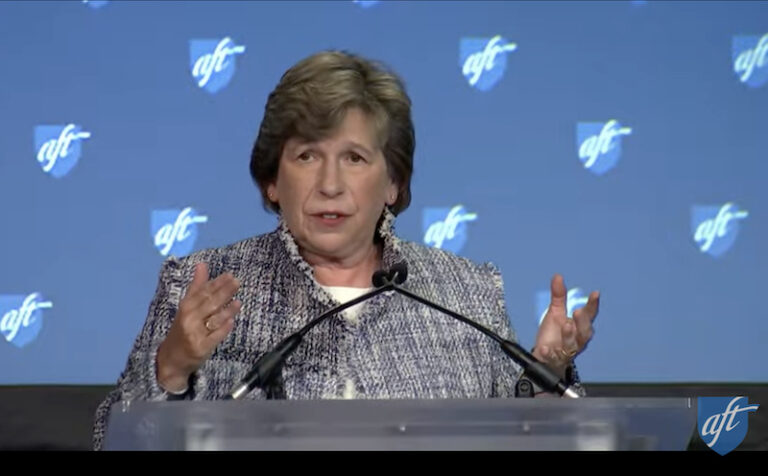
Randi Weingarten, President, American Federation of Teachers

There have been countless wonderful tributes to teachers over the course of this Teacher Appreciation Week. Like many others who have given shout outs to teachers this week — I’ve thought of Mr. Swift and Ms. Gaffney — teachers who made a huge difference in my life. Teachers deserve these accolades and more.

There is nothing nobler than to be a teacher — it is an ongoing act of service that empowers our children and shapes our future. In return, the primary things teachers request are the tools, time and trust they need to do their jobs.

More>>

RU mad about the merger?

Community is incensed by NJ governor’s proposed reorganization of higher ed

NEW JERSEY GOV Chris Christie’s proposal to merger Rutgers University-Camden, the southernmost campus in the state’s flagship research university system, into the heavily debt-leveraged Rowan University has generated a firestorm of opposition, led by studnets, alumni, faculty, staff, unions and local residents in the community.

More>>

Does Mitt Romney Have an Education Platform?

Beyond breaking the unions, what kind of education policy can we expect from a Romney presidency?

Photo Credit: Christopher Halloran / Shutterstock.com

If you’re looking to understand what Mitt Romney might do to education as president of the United States, a good place to start is with his own words. Back in March, Mitt Romney told Fox News’ Bret Baier that his primary educational goal if elected to the presidency would be to weaken teachers’ unions. “The role I see that ought to remain in the president’s agenda with regards to education,” Romney announced, “is to push back against the federal teachers’ unions.” His promise? To diminish the role of the federal government in education policy, except when it comes to union-busting.

This denunciation of teachers’ unions is nothing new for the Right; it’s a plank that has long figured in Republican campaign rhetoric and policy, starting with Ronald Regan. Though Reagan did engage in moderate rhetoric on unions from time to time on the campaign trail, the same moderation was rarely reflected in policy once he was elected. In a nod to his Hollywood roots, Reagan’s 1980 campaign included a pledge of support for the Screen Actors Guild, the actors’ union. And Cold Warrior that he was, he predictably lauded Polish workers who unionized in defiance of the Soviet Union.

Yet overall, Reagan’s relationship with labor in the United States was overwhelmingly hostile. His dispute with the Professional Air Traffic Controllers Association was perhaps the defining union policy of his presidency. He broke that union apart by firing anyone who failed to comply with his imperative to stop striking. And he certainly opposed America’s two largest teachers’ unions, the National Association of Educators (NEA) and the AFL-CIO-affiliated American Federation of Teachers (AFT). Reagan’s anti-unionism set the stage for his party’s contemporary commitment to union-busting, and that included open opposition to the two teachers’ unions.

Ever since, Republicans have worked to demonize – and weaken – both NEA and AFT. This culminated in 2004, when President George W. Bush’s education secretary Rod Paige absurdly called the NEA a “terrorist organization.” So, it isn’t surprising that Romney has chosen to demonize the two unions in his fight to secure his party’s presidential nomination. But as an educational platform, union-bashing’s pretty thin. The sound bites may play well with the Republican base, but what else do we know about Romney on education? He hasn’t made the issue a central component of his campaign — so where can we look to find out what President Romney’s vision for American education might be?

More>>

Weingarten and AFT member discuss tools teachers need to succeed

Randi on Morning JoeAppearing on MSNBC’s Morning Joe show, AFT president Randi Weingarten talks about the tools teachers need to help all children succeed. Those tools include a rich curriculum, time to work together with their colleagues, support to build their professional capacity, a collaborative environment—and more resources, especially to help give lower-income students what they need to overcome poverty. The show was filmed at Fort Lee High School in New Jersey, a public school working hard to improve student achievement.
AFT member Jose Fuentes, a fourth grade math teacher in Newark, discusses the challenges of working in an urban school district on MSNBC’s Morning Joe show. Among the biggest challenges: engaging parents in new ways to get them involved in the school community, large class sizes, and having to dig into his own pockets to buy school supplies for students whose families can’t afford them. Jose Fuentes

South Jersey political boss Norcross mum about Rowan University merger plan

By Bob Braun/Star-Ledger Columnist

Saed Hindash/The Star-LedgerSouth Jersey political boss George Norcross is pictured in this file photo.

Saed Hindash/The Star-LedgerSouth Jersey political boss George Norcross is pictured in this file photo.


Even for a laconic personality like George Norcross, the message was cryptic. Simply the letters “FYI” attached to an e-mail statement written by someone else. Norcross has declined to elaborate, but it was clear the South Jersey political boss was endorsing some or all of the message from Wendell Pritchett, the chancellor of the Camden campus of Rutgers University.

Pritchett opposes the plan, pushed by both Norcross, a Democrat, and Republican Gov. Chris Christie, to allow Rowan University, a former state teachers’ college now saddled with a very expensive medical school, to swallow the Camden assets of what has been New Jersey’s only real state university — Rutgers.

More>>

Occupy Education: Teachers, Students Resist School Closings, Privatizations, Layoffs and Rankings

http://www.democracynow.org/2012/3/1/occupy_education_teachers_students_resist_school

As students across the country stage a National Day of Action to Defend Public Education, we look at the nation’s largest school systems—Chicago and New York City—and the push to preserve quality public education amidst new efforts to privatize schools and rate teachers based on test scores. In Chicago, the city’s unelected school board voted last week to shut down seven schools and fire all of the teachers at 10 other schools. In New York City, many educators are criticizing Mayor Michael Bloomberg’s administration after the release of the names of 18,000 city teachers, along with a ranking system that claims to quantify each teacher’s impact on the reading and math scores of their pupils on statewide tests. “The danger is that if teachers and schools are held accountable just for these relatively narrow measures of what it is that students are doing in class, that will become what drives the education system,” says Columbia University’s Aaron Pallas, who studies the efficiency of teacher evaluation systems. “The effects of these school closings in [New York City] is one of the great untold stories today,” says Democracy Now! education correspondent Jaisal Noor. “The bedrock of these communities [has been] these neighborhood schools, and now they are being destroyed.” Karen Lewis, president of the Chicago Teachers Union, says, “When you have a CEO in charge of a school system, as opposed to a superintendent, a real educator, what ends up happening is that they literally have no clue as to how to run the schools.” Lewis recounts a meeting where she says Chicago Mayor Rahm Emanuel told her that “25 percent of these kids are never going to be anything. They’re never going to amount to anything.” [includes rush transcript]
Filed under Education, Occupy Wall Street, Unions

Guests:

Karen Lewis, president of the Chicago Teachers Union.

Aaron Pallas, professor of sociology and education at Teachers College, Columbia University.

Jaisal Noor, Democracy Now! education correspondent and independent journalist.

http://www.democracynow.org/2012/3/1/occupy_education_teachers_students_resist_school

Interpreting Achievement Gaps In New Jersey And Beyond

Matthew Di Carlo

A recent statement by the New Jersey Department of Education (NJDOE) attempts to provide an empirical justification for that state’s focus on the achievement gap – the difference in testing performance between subgroups, usually defined in terms of race or income.

Achievement gaps, which receive a great deal of public attention, are very useful in that they demonstrate the differences between student subgroups at any given point in time. This is significant, policy-relevant information, as it tells us something about the inequality of educational outcomes between the groups, which does not come through when looking at overall average scores.

Although paying attention to achievement gaps is an important priority, the NJDOE statement on the issue actually speaks directly to the fact, which is well-established and quite obvious, that one must exercise caution when interpreting these gaps, particularly over time, as measures of student performance.

More>>

Weingarten Urges Activism and Advocacy in New Jersey

Adrienne Coles, AFT

Randi Weingarten

Randi Weingarten speaks to AFTNJ and HPAE members at the Rutgers Labor Education Center. Click image for more photos.

As the New Jersey legislative session was set to begin, AFT president Randi Weingarten took some time on Jan. 27 to talk with members of AFT New Jersey and the Health Professionals and Allied Employees about the importance of getting actively involved in political education and advocacy.

New Jersey Gov. Chris Christie is pushing an agenda filled with attacks on K-12 education through undermining tenure and promoting vouchers, as well as a hastily conceived plan to merge higher education institutions. Medicaid is likely to be targeted, and further attempts to diminish public employees’ healthcare and pension benefits are in the offing.

The economy has created an opportunity for the “scapegoaters and the demonizers,” said Weingarten. “Instead of taking the responsibility of governing in tough times seriously, they are pointing fingers” and attempting “to turn the very people who are trying to make a difference in the lives of others into villains.”

It’s unfair, and our members see it, said Weingarten. “They want to know what we are going to do about this. How are we going to make it better?”

AFT affiliates in New Jersey are working on legislation to protect members. “We have to work together, not just with one another, but with state lawmakers to get the best possible legislation,” Weingarten urged. “We have to come together with a quality agenda to engage members.”

Members are understandably frustrated over legislation passed in the last session that has chipped away at the ability to bargain healthcare, changed pension rules and cut funding for education. “We can’t sit it out” this session, Weingarten said. “We have to find a way to work together.”

The last two years have shown us a whole new world, she added. “If you look around this country, you see a new movement growing out of a moment. It’s not just in Wisconsin or Ohio, it’s all over.”

Active, involved members have really made a difference in this movement, Weingarten noted. “Every real movement that is successful has two components: students and the labor movement. You are the key to both.”

Shanker Education Report: Money Matters, Affects Student Performance, Outcomes Money Education

money graphicAmid major slashes to public funding, political leaders have cited assertions that money doesn’t affect student learning to sometimes justify cutting billions in education dollars. But a new report stifles the money-means-education debate, saying that money does matter, and the common political rhetoric has little basis in research.

Friday’s report by the Albert Shanker Institute, titled “Revisiting The Age-Old Question: Does Money Matter In Education?” cites empirical evidence that shows many of the ways in which schools currently spend money do improve student outcomes, and when schools have larger budgets, they’re empowered to spend more opportunistically and productively. Bruce Baker, a professor in the Graduate School of Education at Rutgers University, authors the report. The Shanker Institute is an independent nonprofit endowed by the American Federation of Teachers.

“In short, money matters, resources that cost money matter, and the more equitable distribution of school funding can improve outcomes,” Baker writes. “Policymakers would be well advised to rely on high-quality research to guide the critical choices they make regarding school finance.”

More>>

The Year in Research on Market-based Education Reform: 2011 Edition

Matthew Di Carlo, Senior Fellow, Albert Shanker Institute

If 2010 was the year of the bombshell in research in the three “major areas” of market-based education reform — charter schools, performance pay, and value-added in evaluations — then 2011 was the year of the slow, sustained march.

More>>

Powered by Union Labor