Category Archives: News

Gov. Christie, Sen. Sweeney break ground on cancer center at Camden hospital

By Megan DeMarco/Statehouse Bureau.

TRENTON — It made for an impressive tableau: Three of the most powerful politicians in New Jersey united today for a groundbreaking in Camden, just miles from the Rutgers campus that is the focus of a controversial takeover championed by the same three men.

Cooper

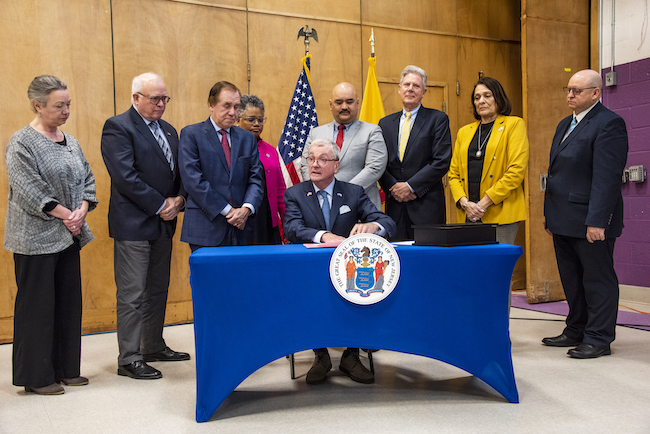
Ed Murray/The Star-LedgerGov. Chris Christie, Senate President Stephen Sweeney and George Norcross attended a ceremonial groundbreaking for a cancer center at Cooper University Hospital in Camden.


Gov. Chris Christie, Senate President Stephen Sweeney (D-Gloucester) and George Norcross, chairman of Cooper University Hospital, all wielded ceremonial shovels for the start of a four-story cancer center for Cooper that is scheduled to open in the fall of 2013.

More>>

Outraged Kean faculty and librarians vote ‘No Confidence’ in Trustees

Overwhelming 94% agree that guardians of university refuse to check failed leadership

UNION, NJ…University faculty and librarians have overwhelmingly voted no confidence in the Kean University Board of Trustees for their inaction despite multiple ongoing crises that threaten the schools’ academic and athletic programs and financial stability. “We need Trustees who have the independence and integrity to make decisions in the best interests of Kean’s current and future students regardless of political influence,” said Kean Federation of Teachers (KFT) President James Castiglione. “The Trustees are charged to represent the public trust—an important commitment. This vote shows that our faculty and librarians have lost faith in the Trustees’ willingness or ability to perform their basic oversight duties as they have allowed university management to exercise unchecked power and to evade any accountability.”

Outraged Kean faculty and librarians vote ‘No Confidence’ in Trustees

Officials discuss compromise in Rutgers-Rowan merger: A combined institution with an independent board

By Kelly Heyboer/ The Star-Ledger

A tentative compromise is in the works that could save the controversial propsosal to merge Rutgers-Camden with Rowan University, higher education officials said today. The framework for the deal calls for creation of a combined institution in South Jersey that would be controlled by an independent board but retain some form of the Rutgers name, the officials said.
Under the plan, negotiated behind the scenes by a group of state lawmakers and university officials, Rutgers would still oversee how degrees are awarded and other academic issues but would have no authority over day-to-day operations of its Camden campus, those involved in the talks say.
“There is a conceptual plan,” said Peter McDonough, Rutgers’ vice president for public affairs and one of those involved in the talks. “We think we’ve got a loose framework.”
The plan still faces review by Rutgers’ governing boards and Gov. Chris Christie, who has pushed for the merger and so far has given no indication he is willing to compromise on the plan — which has faced strong opposition on the Rutgers-Camden campus and among many in the Legislature.
Several top lawmakers and university officials — including Rutgers President Richard McCormick, state Senate President Stephen Sweeney (D-Gloucester), state Sen. Donald Norcross (D-Camden), Newark Mayor Cory Booker, Rutgers-Camden Chancellor Wendell Pritchett and Rutgers Board of Governors members Ralph Izzo and Joseph J. Roberts Jr. — have been meeting for weeks behind closed doors and by telephone to come up with a compromise.
George Norcross, the powerful South Jersey political boss and the brother of Donald Norcross, has also been pushing all parties to salvage parts of Christie’s merger plan and create a unified research university based in Camden.
“I actually am involved in trying to form an agreement here,” George Norcross said during an editorial board meeting today at The Star-Ledger’s offices in Newark. “I am trying to put Humpty Dumpty back together again.”
Norcross said he suggested the new Camden school to be named “Rowan-Rutgers University.” But others involved in negotiating the compromise said no name has been chosen.
Those involved said many details about the compromise still needed to be worked out and there is no written proposal yet to present to Christie, the Legislature or the Rowan and Rutgers governing boards.

More>>

Rutgers: Framework in place for university shift

By GEOFF MULVIHILL, Associated Press

Rutgers University officials said Monday a new framework is in place for the university to keep its campus in Camden rather than see it folded into another state university under a plan backed by Gov. Chris Christie.

Rutgers-Camden Chancellor Wendell Pritchett said in a statement Monday that the plan would give his campus more administrative and budgetary autonomy from Rutgers’ main campus in New Brunswick. The school also would “engage in a deep and meaningful partnership with Rowan University,” Pritchett said.

The plan, which was first reported by The Star-Ledger of Newark, is an alternative to one to merge Rutgers’ Camden campus into Rowan as part of a broader reorganization of higher education institutions in the state. Christie, a Republican, has said he wants the changes to take effect by July 1 though it’s certain that implementing the details would take well beyond then, possibly several years.

Rutgers-Camden students, faculty and alumni mostly oppose the merger, as does Rutgers’ Board of Trustees. They object to losing the respected Rutgers identity and say there would be problems in combining a campus of a research university with a state university that’s primarily a teaching university.

Christie has not signed off on the alternative plan, which is being hashed out by a group of lawmakers and higher education officials. Rutgers Vice President of Public Affairs Peter McDonough said that the new concept isn’t in writing.

It’s unclear how likely the proposal is to be implemented.

More>>

Video: George Norcross: I support the merger

How Corporations Like Monsanto Have Hijacked Higher Education

By Jill Richardson

Academic research is often dictated by corporations that endow professorships, give money to universities, and put their executives on education boards.

Here’s what happens when corporations begin to control education.

Photo Credit: Shutterstock/mostafa fawzy

Photo Credit: Shutterstock/mostafa fawzy


“When I approached professors to discuss research projects addressing organic agriculture in farmer’s markets, the first one told me that ‘no one cares about people selling food in parking lots on the other side of the train tracks,’” said a PhD student at a large land-grant university who did not wish to be identified. “My academic adviser told me my best bet was to write a grant for Monsanto or the Department of Homeland Security to fund my research on why farmer’s markets were stocked with ‘black market vegetables’ that ‘are a bioterrorism threat waiting to happen.’ It was communicated to me on more than one occasion throughout my education that I should just study something Monsanto would fund rather than ideas to which I was deeply committed. I ended up studying what I wanted, but received no financial support, and paid for my education out of pocket.”

Unfortunately, she’s not alone. Conducting research requires funding, and today’s research follows the golden rule: The one with the gold makes the rules.

More>>

Teacher Appreciation — More Than Just a Week?

Randi Weingarten, President, American Federation of Teachers

There have been countless wonderful tributes to teachers over the course of this Teacher Appreciation Week. Like many others who have given shout outs to teachers this week — I’ve thought of Mr. Swift and Ms. Gaffney — teachers who made a huge difference in my life. Teachers deserve these accolades and more.

There is nothing nobler than to be a teacher — it is an ongoing act of service that empowers our children and shapes our future. In return, the primary things teachers request are the tools, time and trust they need to do their jobs.

More>>

A Generation Hobbled by the Soaring Cost of College

By ANDREW MARTIN and ANDREW W. LEHREN

student debt

Photographs by Ruth Fremson/The New York Times and Ty William Wright for The New York Times Taking on debt has become a central part of the college experience for many students.

ADA, Ohio — Kelsey Griffith graduates on Sunday from Ohio Northern University. To start paying off her $120,000 in student debt, she is already working two restaurant jobs and will soon give up her apartment here to live with her parents. Her mother, who co-signed on the loans, is taking out a life insurance policy on her daughter.

“If anything ever happened, God forbid, that is my debt also,” said Ms. Griffith’s mother, Marlene Griffith.

More>>

RVCC adjuncts eye raises, too

Written by Sergio Bichao

BRANCHBURG — They teach the most classes and are probably seen by the most students, but unlike their full-time counterparts, the adjunct professors at Raritan Valley Community College are afraid they won’t get a raise.

The college of Somerset and Hunterdon counties recently settled contracts with its full-time professors, administrators and staff, awarding them a 3 percent raise next year and no raise this year.

The negotiations come as students face a $450 tuition hike next year.

The counties slashed their tax-funded support of the school by 5 percent this year, contributing to a $3 million budget shortfall for the school.

RVCC’s $49 million budget calls for the elimination of 12 full-time administrative and staff positions, which have not been identified, spokeswoman Donna Stolzer said Friday.

School officials declined to comment on ongoing negotiations, but union officials this week said the administration was pushing for new raises for the adjunct faculty, which teach nearly 55 percent of the classes at RVCC and who outnumber the full-time professors 441 to 122, according to the school.

More>>

N.J.’s paid family leave program strengthens families, businesses

By Karen S. White and Phyllis Salowe-Kaye
What to get Mom for Mother’s Day?

babies

WALTRAUD GRUBITZSCH/AFP/Getty Images Babies are pictured in this file photo. The authors say paid family leave for new mothers in New Jersey strengthens families and businesses.

How about more time with her family? Isn’t that was she really wants? And how about family time without the demands and pressures of a job to interfere? Wouldn’t it be great if Mom could, say, spend six weeks of paid time off bonding with a new baby?
Here, in New Jersey, she already can.
The state, over the past four years, has created a tremendously successful family leave insurance program that provides paid time off for workers who are dealing with the most major of life’s events — the birth of a child, a sick relative, adoption.
New Jersey is only the second state to provide paid family leave, after California.
The program has been nothing short of a smashing success, providing more than 80,000 workers — four out of five of them women — with partial wage replacement for family leaves that average 5.2 weeks, according to Department of Labor and Workforce development statistics.
The act was the product of years of effort by advocates such as the New Jersey Time to Care coalition, which worked with lawmakers, national partners and union leaders to come up with a family leave insurance program that doesn’t cost employers a dime.

More>>

Powered by Union Labor